'Humanity Should Not Surrender Control To AI': Meta AI Chief Alexandr Wang On The Imminent Arrival Of Superintelligence
· Free Press Journal
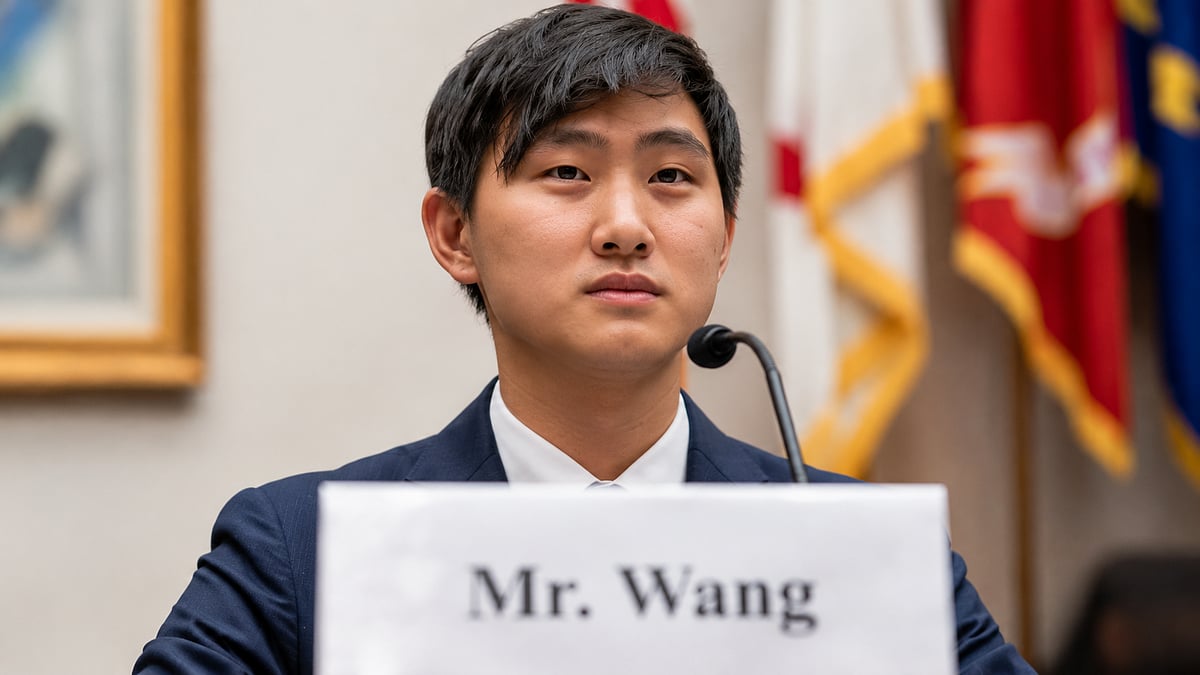
Alexandr Wang, Meta's first chief AI officer, who leads Meta Superintelligence Labs, has said society should not accept a 'handover' to artificial intelligence. In an essay published on X, he argues that the industry should aim to build technology that gives all humans greater agency and empowerment. He says he strongly believes this is possible, but that it will likely require the whole industry to take meaningfully different actions from the 'default path' in front of it.
Why he fears losing control
Visit asg-reflektory.pl for more information.
Wang says it is hard to imagine humanity keeping control over unconstrained recursive self-improvement. He says it is equally hard to imagine control over a superintelligence 1,000 times smarter and more capable than humans in every field. He warns that nearly every field could be accelerated at a pace humans cannot understand or monitor. In his view, how humanity acts over the next year will have great consequence for the future world.
— Alexandr Wang (@alexandr_wang) November 22, 2026
A rebuke of the industry's script
Wang says he has noticed a particular form of lazy thinking within the AI industry. It holds that ASI is inevitable and that the only problem to solve is doing it safely. He says much more is at stake. He argues that the industry must go beyond progress on safety, alignment and security, and must also think through how it progresses thoughtfully. He does not say whether Meta's own approach is part of the default path.
Capability is no longer the hard part, he says
The warning rests on a bold premise. Wang says the scientific and technical problems of capability progress are likely solved. He says the remaining gaps for AI to greatly surpass humanity in every field are no longer intelligence. They are domain-specific know-how, plumbing and experimentation. He traces the shift to December 2024, when models began acing the AIME, the US maths contest for high-school students. He says coding is now nearly solved, and that powerful cyber and agentic capabilities have emerged.
Unequivocal super intelligence has arrived.
— Elon Musk (@elonmusk) November 22, 2026
Welcome to the Singularity.
Wang expects AI to become the greatest contributor to progress across nearly every field. He says this is likely true of AI research itself, which he calls far less demanding than the Riemann Hypothesis. He expects models to automate it and to improve themselves in clearly superhuman ways. He also expects them to speed up biological, weapons and economics research.
The Riemann claim behind the warning
Wang calls the proof of the Riemann Hypothesis the clearest sign of a significant change, and says it was completed with the help of an 'alien mind' humans don't understand. His essay does not name the proof or its authors. The claim came on November 20, when mathematician Levent Alpoge said he had found a proof with Anthropic's Claude. His work has cleared several important computer-based verification checks. A separate proof by Stanford researcher Alessandro Maria Masullo, developed without AI, has drawn queries from mathematicians. Scientific American has reported that independent mathematicians consider the AI-assisted proof almost certainly valid.
Level up your brain the fun way. Play daily games and quizzes on FPJ Smart!