Three Scenarios for Israel
· The Atlantic
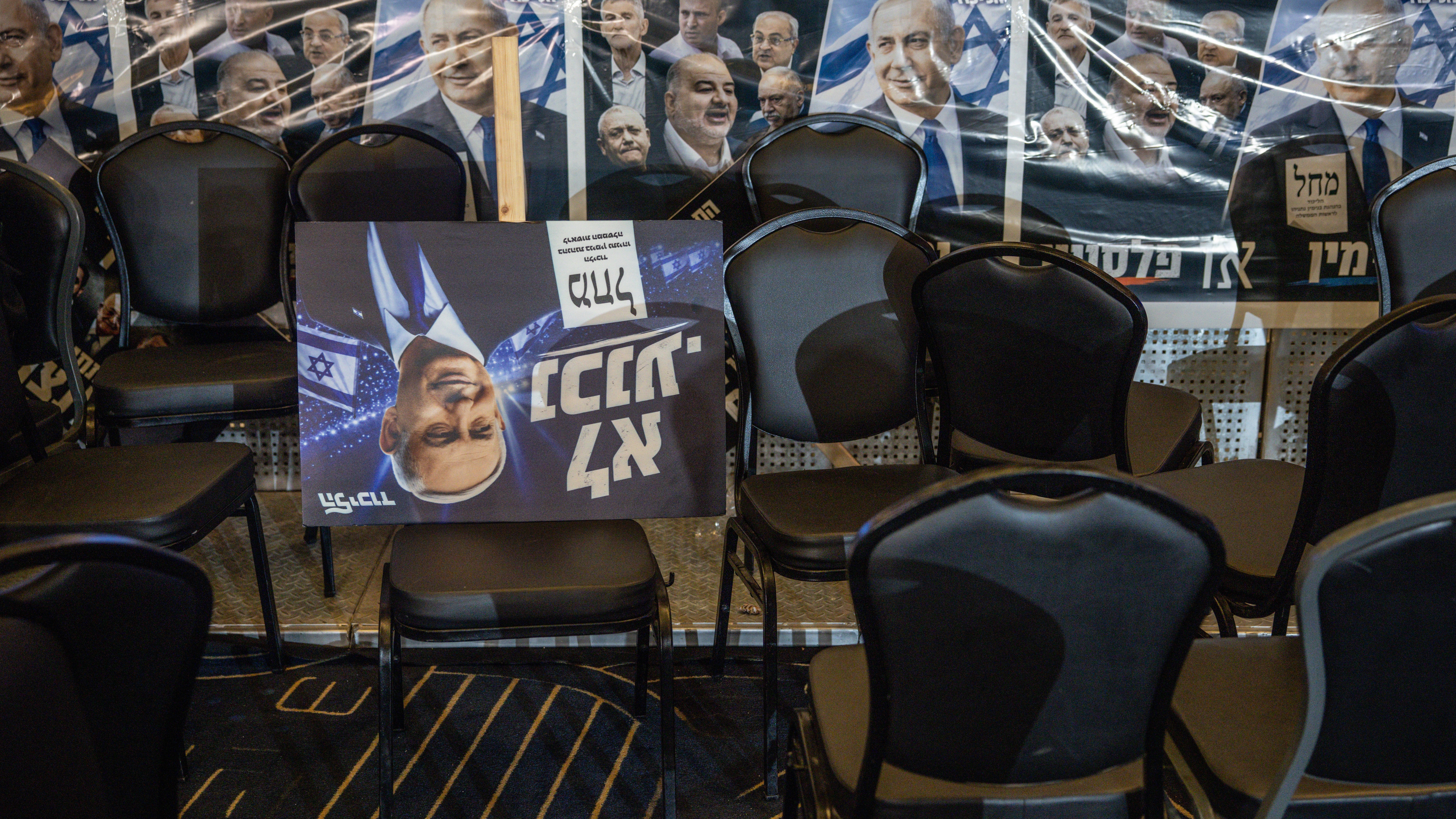
Before yesterday’s Israeli election, the only universal desire was for a conclusive result. The two possible conclusions: continued government by Prime Minister Benjamin Netanyahu, or a government headed by one of his opponents. In central Tel Aviv, supporters of opposition candidates drove around the main streets and hectored pedestrians and café dwellers to go vote for anyone at all who was not Netanyahu. In Jerusalem, the opposite messaging dominated. On Jaffa Street, a large, dystopian sign showed Netanyahu’s notorious overseer of prisons, Itamar Ben Gvir, grinning and looking like a self-satisfied tardigrade next to three bound, kneeling men. At the Jerusalem train station, a flyer with the face of Finance Minister Bezalel Smotrich had blown onto a commuter footpath. In lieu of conducting an exit poll, I loitered and watched as most people respectfully sidestepped it, a few stepped on it, and finally one woman paused to grind the toe of her Mary Jane into Smotrich’s face. I later saw her board my train to Tel Aviv.
The voting results are mostly in, and they are less conclusive than everyone hoped, and than either side is willing to admit. (Both sides have said the results show that the public favors them.) Netanyahu’s current coalition can no longer form a government on its own. Neither can the opposition. Arab-majority parties are likely to hold 19 seats out of 120. Parties can form a government by: (1) negotiating a unity government, with elements of the opposition and of Netanyahu’s current coalition; (2) combining Arabs and the opposition; or (3) combining Arabs and the current Netanyahu coalition. If this election were a Magic 8 Ball, the result would be Reply hazy, try again. (In the exasperating event that no government forms, Israel will hold another election in a few months, and Netanyahu will remain in power in the interim.)
Visit michezonews.co.za for more information.
[Graeme Wood: Netanyahu goes into full panic mode]
The next days or weeks will be consumed with backroom deals, to see if the parties can negotiate any of the three scenarios above. Each possibility would demand that a party give up something it previously described as nonnegotiable. In Scenario (1), the opposition might have to compromise on the main motivation for their campaign: anyone but Netanyahu. After an unusually personal election, the person the opposition existed to repudiate would likely remain in power in some form, as the leader of the largest single party in the Knesset. Under one conceivable bargain, Netanyahu would remain in office for two more years, then rotate out, perhaps in favor of Naftali Bennett, just as Donald Trump finishes his term.
Scenario (2) would require the opposition to cooperate with Arab parties. Willingness to cooperate with those parties ranges from enthusiastic (in the case of the leftmost party, the Democrats) to hell-no (in the case of Yisrael Beiteinu, on the opposition’s secular-nationalist right). The scenario would deliver a fragile majority, but only if the hell-nos, as well as many other opposition leaders who have publicly ruled out cooperation with Arab parties, are somehow persuaded to change their minds.
In Scenario (3), Netanyahu, whose coalition is widely associated with the persecution of Arabs, joins forces with Arab parties to remain in power. This is the weirdest of all, and so improbable that if it takes place, Israel will need immediate public-health announcements to assure the population that the water supply has not been spiked with hallucinogens. Mansour Abbas, the canny leader of the Islamist Ra’am party, told Israel’s Channel 12 that “the right wing” has already approached him to discuss the prospect of working together. Netanyahu made overtures to Arab parties in 2021 as well, though not on the scale that would be necessary here. The details of the right’s discussion with Abbas remain mysterious, and even if both Arab parties cooperated with Netanyahu’s party, Likud, other far-right parties that are far more hostile to Arabs would have to consent to the arrangement, or be replaced in the coalition by an opposition party. But Netanyahu’s position on the right gives him paradoxical latitude in making concessions to Arab political interests, because fewer politicians on the right will feel that they can roast him for doing so. If Netanyahu makes a deal with Arab Israelis, the deal might stick. Skepticism about this possibility is warranted. But ask yourself: Why did the Israeli right call Abbas? Out of politeness? Boredom? As a bluff, to pressure other parties?
[View: Flying across the world to vote]
All three scenarios would demand difficult or unlikely compromise, and some other possibilities (such as defections within the anti-Netanyahu camp) could spawn more options. Cutting out the Arab parties seems most likely. To Netanyahu’s opponents, partnering with their sworn enemy, albeit a fellow Zionist, is distasteful. But partnering with Arab parties—whose commitment to Israel’s identity as a Jewish state is half-hearted at best, and with whom most opposition parties have serious disagreements about security and other policy areas—would force introspection that is more comfortably postponed. Arab Israelis, who make up about a fifth of the population, have representatives in the Knesset. But their colleagues isolate them like some kind of contagion (and some Arabs have preferred that isolation to complicity in a Jewish-led national project).
Before the election, I spoke with Jacob Abolafia, an American University political scientist, who predicted that the Arab parties would be necessary partners if the opposition wanted Netanyahu out. “It’s the only mathematically stable way to get an anti-Netanyahu coalition,” he told me. But the opposition leaders know, he says, that if they openly court Arabs, the opposition coalition will crumble, because the electorate is permeated with anti-Arab sentiment. “Are Arabs full citizens of Israel, or are they not?” he asked. “There are internal contradictions in Israeli society that are too great to solve right now.” That may be so. But it appears that every path forward involves resolving at least one contradiction or incompatibility. It’s just a matter of deciding which.